8.1 Five places an answer comes from
- Status
- stable
- Owner
- Panaversity
- Approved
- Panaversity ·
In everyday life. You ask a friend when the pharmacy closes. They might read the sign in front of them (context), or remember what you told them last week (memory). They might know that your prescription was ordered Monday and promised for Thursday (the case file, the job SSoR does). They might quote the pharmacy's official hours (the official record, the job KSoR does). Or they might call to check whether it closed early today (current state, the job DSoR does).
What you will learn. How to tell which of five places an AI Worker's answer came from, and which of them can give the final answer about a rule or a payment. You practice it in step 1 of the build step.
Why it matters. A wrong answer can sound just as sure as a right one. Where an answer came from tells you whether to trust it.
An AI Worker's answer can come from five places, and they are not the same kind of thing. The last three, SSoR, KSoR and DSoR, are systems of record: each is the official source for one kind of fact. The table's examples come from Brightline Wholesale Supply, the book's example company, and its AP Worker, the AI Worker that handles the bills Brightline owes. AP means accounts payable. Maria is the office manager, and Dave, the controller, runs Brightline's accounting.
| Context | Memory | SSoR | KSoR | DSoR | |
|---|---|---|---|---|---|
| The question it answers | What can the worker see right now? | What does it remember about you? | Where does this matter (one piece of work, such as an invoice) stand, and how did it get here? | What is officially true here? | What is true right now? |
| Who writes it | You, your files and the conversation | The AI product, from your chats | Systems, AI Workers and people, each entry checked when it is added | A person who drafts it, then one who approves it, under a named owner who is responsible for it | The company's systems |
| How long it lasts | This conversation | Until edited or deleted | Kept. A correction is a new entry, and the old one stays | Until someone with authority changes it | As recorded, until it changes |
| AP example | The invoice you just attached | "Maria wants replies in plain English" | "Invoice 5149: callback October 22, held October 23, paid October 30" | "Invoices over $5,000 need the controller's approval" | "Invoice 5149 is paid" |
- Context is what the worker sees now.
- Memory is non-authoritative continuity: preferences, experience and where to look. It helps the worker carry on from past chats, but it never has the final word.
- SSoR, the State System of Record, is the governed record of each matter. Governed means kept under rules about who may add, approve or change it. A matter is a piece of work carried to an end, such as an invoice from receipt to payment.1 Think of it as the matter's case file: where it stands, how it got there, and the evidence for each step.
- KSoR, the Knowledge System of Record, is the governed knowledge layer: what the company has approved as true.2
- DSoR, the Data System of Record, governs state and action: it reads what is currently so in the real systems, and checks every action against authority. State is where things stand now, such as whether an invoice is paid. The ERP, the ledger and the vendor records stay authoritative underneath it.3 These are the company's own systems: the ERP is its main business software, and the ledger is its record of accounts.
DSoR is an open specification, and Part IV of this book teaches it in depth. SSoR is a published design. In Part II, this part of the book, you read current state from the company's systems yourself, and keep the SSoR record by hand.
These are five places to manage, not five separate parts inside the AI. The worker works only from its context. The other four reach it only by being put into that context. What settles a question, or gives its final answer, is where the content came from, not how it reached the worker.4 For example, "Invoice 5149 is paid" settles the question when it was read from the accounting system, not when memory supplies it.
One fact, one authority. This is the rule in SSoR's design that keeps SSoR, KSoR and DSoR apart. Every fact has exactly one named authority, and every copy carries a record of where it came from.1 The authority is the source whose word is final for that fact:
- KSoR settles policy.
- The company's systems settle current state, and DSoR reads them.
- SSoR settles the record of the matter: what was received, what was believed and why, and what was decided.
SSoR does not settle whether 5149 is paid right now. When SSoR shows 5149 paid, it records what the authority said and when. Its latest-known status is only that: the latest known, as of its date.
Two rules follow.
- Memory never overrides the other four. If memory disagrees with any of them, memory loses.
- A rule and a fact are different things. "Invoices over $5,000 need approval" is knowledge. It stays true until someone with authority changes it. "Invoice 5149 is unpaid" is state. It was true on October 23, and it changed when 5149 was paid on October 30. A file can hold knowledge safely if someone owns it. A file that holds state is a snapshot: evidence of its date. It is out of date as soon as the state changes.
In the chapter's opening story, the AP Worker gave four wrong answers. Each came from the wrong place:
- Whether invoice 5149 was paid came from an out-of-date file. SSoR would have shown its history, and the accounting system would have shown its current state.
- The approval threshold, the amount above which an invoice needs Dave's approval, came from memory.
- The rule for a vendor's new bank details came from notes that nobody owned.
- A standing instruction, a rule meant for every conversation, came from context alone. When the long conversation was condensed, the worker stopped following it.
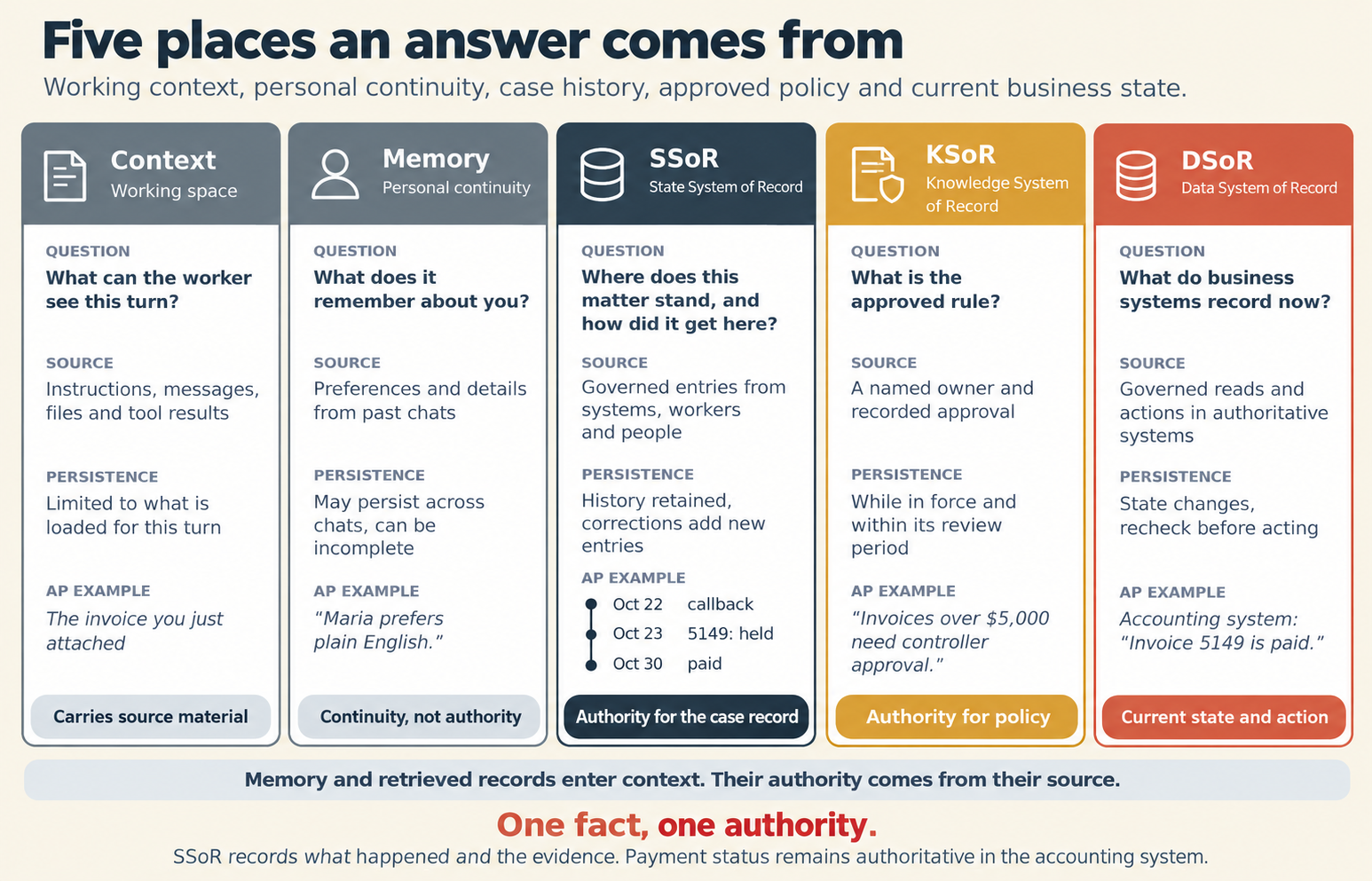
Figure 8.1. Five places an answer comes from.
Figure 8.2 asks one question about current state, whether invoice 5149 is paid, and shows five answers that might come back.
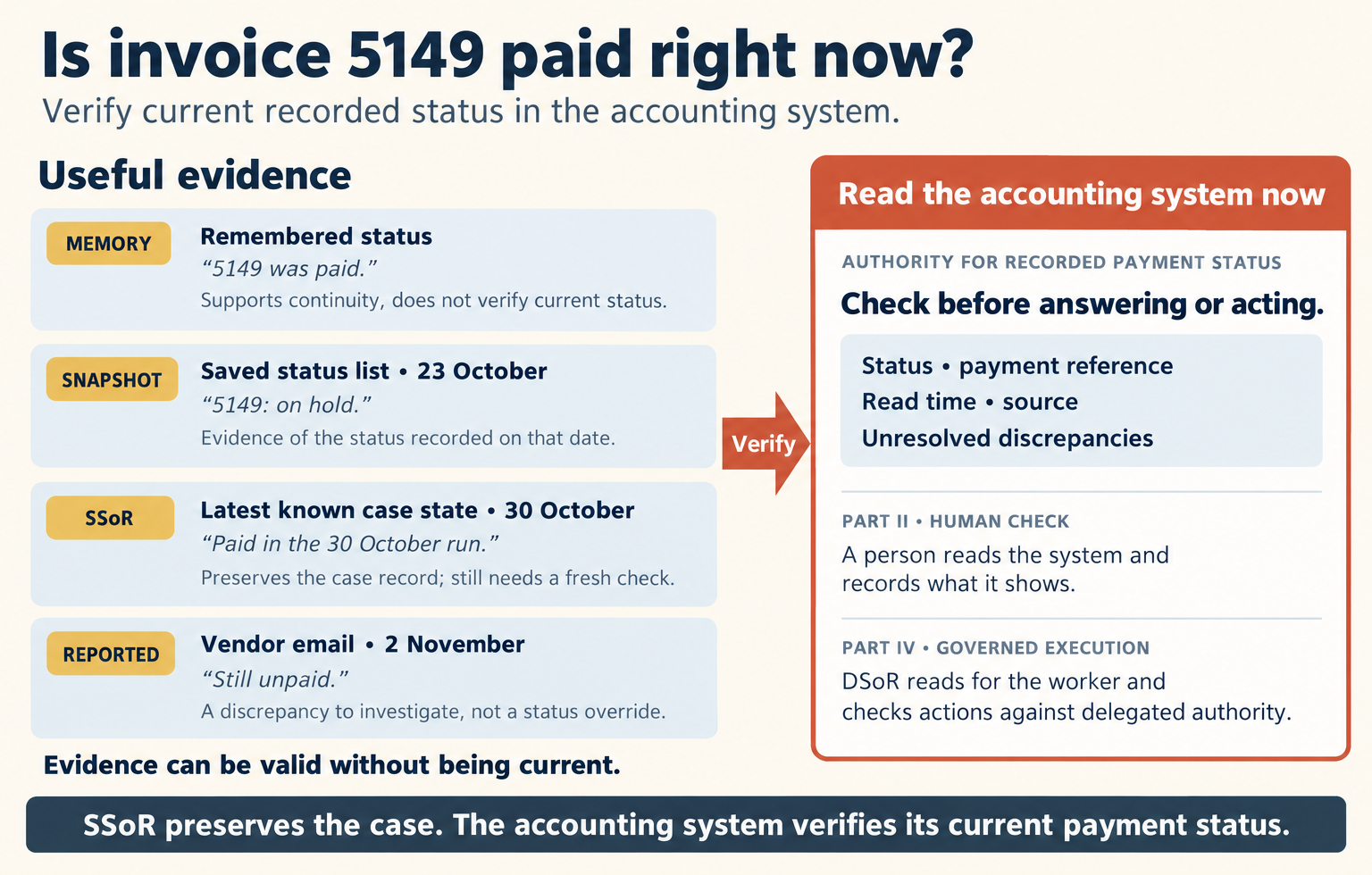
Figure 8.2. Memory, an old snapshot, SSoR's latest-known line and a vendor's email may each be true, but none settles whether 5149 is paid now. Only the accounting system, read now, settles it. In Part IV, DSoR does that reading for the worker.
Check yourself
Question 1 / 8 · current
0 answered
Which question does approved knowledge, the KSoR, answer?
Sources
Chapter 8. Context, Memory, Knowledge and State
How to tell where an AI Worker's answer came from, what to do with a long conversation, how to set up a project on Claude or ChatGPT, and how to own approved knowledge and keep every copy of it current.
8.2 Context: what the worker sees now
What an AI Worker can use when it writes its next reply, why a long conversation loses details, and why a bigger window does not solve it.