Part II. Managing AI Workers
- Status
- stable
- Owner
- Panaversity
- Approved
- Panaversity ·
Note
You are here: Part II. Managing AI Workers
| Journey | Where you are |
|---|---|
| Capability | You can describe an AI Worker as a role. This part teaches you to manage one, which means you brief it, set its authority, review its work, and own the knowledge it answers from. |
| Certification | Prepares you for PCAO-F across all seven CCAO-F domains, with the Associate companion. Next exam: PCAO-F, at the end of this part. |
| Economic | You can be trusted to delegate real work and check what comes back. That is portfolio milestone A, and the exit point for the everyday professional route. |
- Portfolio artifact: the Part II capstone. It is made of a verified example of delegated work, its review contract, and a small governed KSoR (milestone A).
- Who reads it: everyday professionals, builders and domain experts read all seven chapters in full. The enterprise and national leader route skips this part.
- Domain experts: in Parts III to V, every chapter carries a status that tells you how deeply to read it. The four statuses are Required, Manager, Co-build and Builder-only.
- Before you start: Part I, and your Role Contract draft.
- What comes next: routes divide. Everyday professionals: PCAO-F, then Chapter 34. Builders: Part III. Domain experts and founders: your chapters in Parts III to V, then Part VI.
What this part is about
We have moved from the chatbot paradigm to the AI Worker paradigm. The winners will be the people, companies and countries that learn to manage, build, govern, deploy and export AI work.
Part II is about the first verb in that list, manage. It is also about the question every manager asks before handing over real work: can I delegate this, and can I trust what comes back?
Handing over the work is now the easy part. The hard part is everything around it. You need to say clearly what you want, decide what the worker may do alone, and give it the right knowledge. You also need to check a result you did not watch it produce. If you skip those steps, you get output that looks right but is not.
This is the judgment layer. It works the same way on Claude and on ChatGPT. Better models do not remove it, because more convincing output makes checking matter more, not less. You need no technical background, and you write no code. The chapters also carry the first edition's Seven Principles, the discipline of a delegated session. They appear as working habits, not as a list to memorize.
What you will be able to do
By the end of Part II you can:
- brief a task by its outcome, format, inputs and autonomy, and name only the steps that must be followed
- write the checks before you delegate, and tell the difference between good output and output that only looks good
- set what a worker may observe, recommend, draft or execute, and when it must escalate
- keep context, memory, governed knowledge and live data separate, and own a small collection of governed knowledge
- decide when work should run on a schedule or a trigger, and govern work you did not start
- say when AI use is inappropriate, what data must stay out, and when a human must sign
- read a task record, the worker's record of the run, when something fails, and fix the brief, the inputs or the permissions
The part capstone
Part II ends with one piece of work that uses all of this. You take a real accounts-payable task and write a Four-Part Brief for it. The worker must answer from your own KSoR (Knowledge System of Record), the governed knowledge you build in Chapter 8. It must also stay inside the Authority Envelope, the exact limits of what it may do, which you set in Chapter 7. Before you delegate, you write the review contract. Then you review the result against it and trace every claim. Each policy claim points to an approved concept. Each fact points to the task's inputs or its record. Each calculation can be redone by someone else. Each assumption is labeled as an assumption. You do the whole task in Claude, then repeat it in ChatGPT.
Brightline is an example to follow, and you are not limited to it. If you are applying the book to your own field, do the capstone on a real task from your role. The worker answers from five approved concepts in your field. If you do not yet have a role of your own, do the Brightline AP version. It counts in full as your Part II capstone.
The capstone is graded on the book's standard rubric, which has six criteria. Each criterion is scored Not yet (1), Meets (2) or Exceeds (3). Five of them are shared by every part: outcome, evidence, governance, portability and communication. The sixth is Part II's own: the review contract was written before delegation. To pass, you need at least Meets on every criterion and 14 or more of the 18 points. If you get Meets on every criterion, you score 12 points, so a pass also needs Exceeds on at least two criteria.
This means two things. First, a contract written after the run fails the capstone, even if the result is good. This is because it cannot show that you set the acceptance criteria before you saw the output. Second, under the governance criterion, the worker must have stayed inside its Authority Envelope. A good answer does not pass if the worker reached it through an action that the Authority Envelope did not allow.
The capstone, with its review contract and your KSoR, is your evidence for portfolio milestone A, Manager.
Your role in the running project: knowledge owner
The running project is the accounts-payable (AP) Worker for Brightline Wholesale Supply. Brightline is the book's fictional distributor in Columbus, Ohio, with about 40 staff. Brightline's office receives vendor invoices every week. Someone has to record them, check them for duplicates and errors, and prepare them for payment. In Part I you wrote a Role Contract for that worker, or for a role in your own field. In Part II you start managing the worker, and you take on a specific job: knowledge owner.
A knowledge owner decides which policy and domain knowledge the worker may treat as approved. At Brightline, that means the AP policy: for example, the approval thresholds and the capitalization policy. In Chapter 8, you write five of those policies as approved concepts in a small KSoR. Each concept has an owner, an approval status, a version and an effective date. That record is the one authoritative source. The worker's answers about AP policy should come from it, not from the model's general knowledge or from a file someone uploaded last year.
You make the concepts available to Claude and to ChatGPT through each product's own project knowledge or connectors. This needs no server and no code. The concepts in each product are copies, for now. When a policy changes, you change it once in the KSoR, then refresh each copy and note which version it now holds. Updates can reach workers automatically only through a live connection, which comes in Parts III and IV. Approved knowledge can still be out of date or wrong, and that is why it has a named owner.
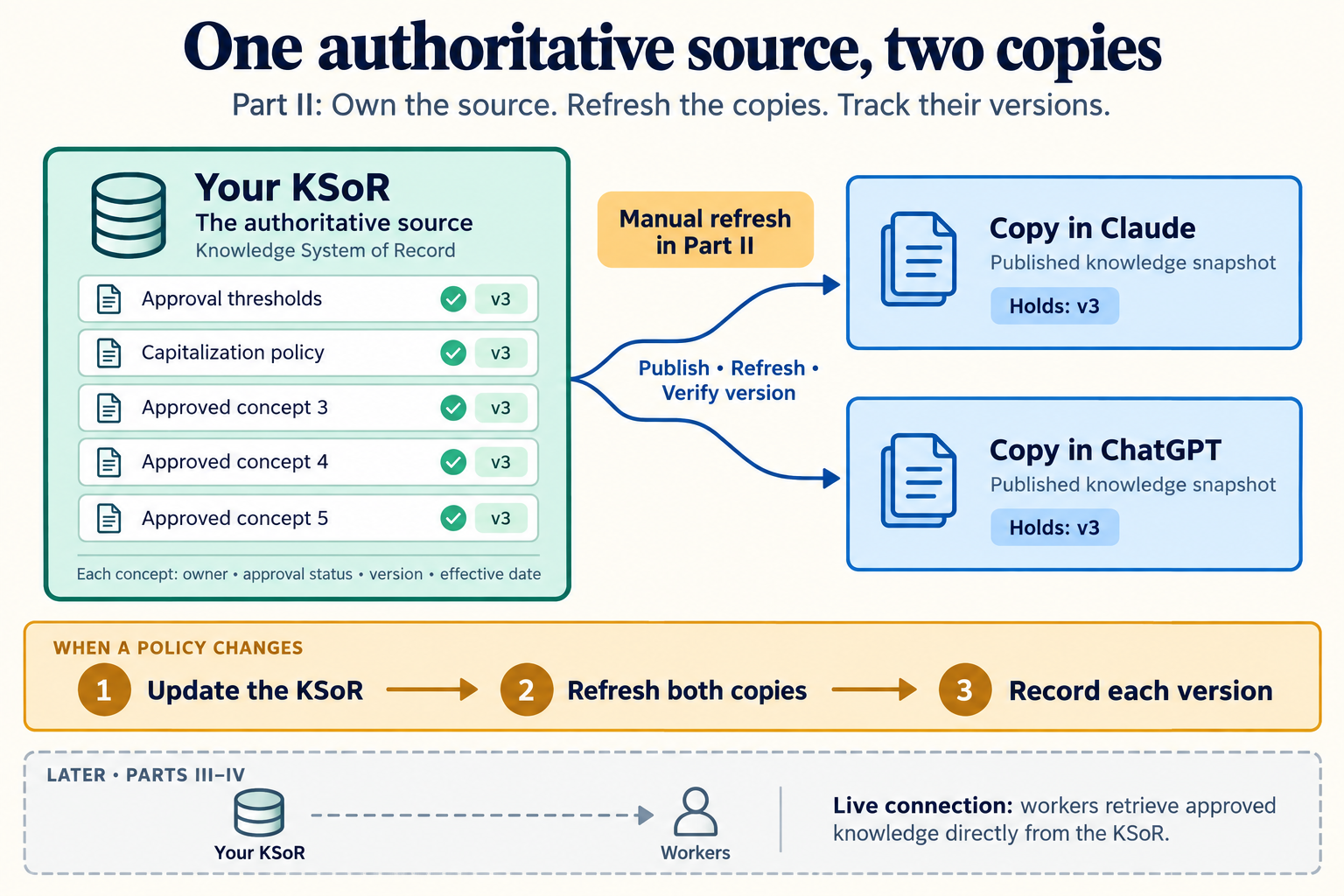
Figure II.1. One authoritative source, two copies. In Part II, you refresh the copies yourself. Parts III and IV replace them with a live connection.
The other half of the architecture, DSoR (the Data System of Record), stays a concept in this part. Chapter 4 introduced it. Chapter 7 returns to it with the Authority Envelope, so you know where the worker's power to act will be checked. The worker in Part II answers, drafts and recommends. It does not yet pay anyone.
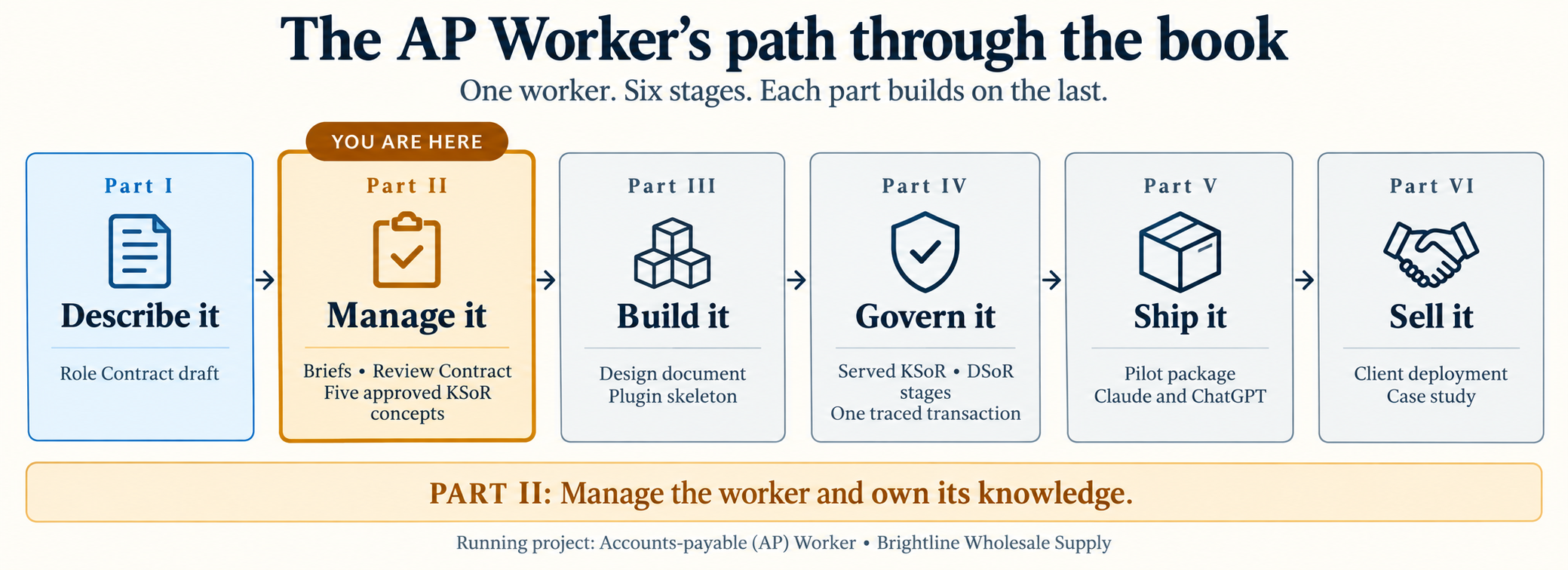
Figure II.2. The AP Worker's path through the book. Most labs keep the same company and role, so each part adds to what you made before.
The seven chapters
Chapters 5 to 8 cover what you set before the worker starts: the brief, the checks, the boundary and the knowledge. You set these in the first 10 percent of the rhythm from Chapter 3. Chapters 9 and 10 widen the view from one task to ongoing work and to company rules. Chapter 11 covers what to do when the worker goes wrong.
| Chapter | What it teaches | What you make |
|---|---|---|
| 5. The Four-Part Brief | Brief the outcome and any required steps or controls, and leave the rest of the method to the worker. Name the governed source as an input. Break big requests down, iterate, and choose the output format | One AP brief, run in Claude and in ChatGPT Work, with the two results compared |
| 6. The Review Contract | Agree on the checks before you delegate. Find hallucination, inconsistency and bias. Check the numbers a decision depends on. An answer that cites nothing is a warning | A review contract for an AP task, written before the task runs |
| 7. The Authority Envelope | Four levels of permission: observe, recommend, draft and execute, with escalation open at every level. The worker escalates whenever it reaches a limit, an exception or real doubt. Permissions set the blast radius, the worst damage a wrong action can do. Untrusted input together with the power to act is a risk. Keep the two apart. The clerk analogy for DSoR | The AP Worker's Authority Envelope, added to your Role Contract |
| 8. Context, Memory, Knowledge and State | Context is what the worker sees now. Memory is what it remembers. KSoR is what is officially true. DSoR is what is true right now. When to restart, summarize or persist | Your first KSoR: five approved AP concepts, connected to Claude and to ChatGPT |
| 9. Work That Runs Without You | Is this an agent problem at all? Scheduled and triggered work. Standing workers, and how to govern initiative you did not ask for | A plan for one recurring AP task: its trigger, its limits and who is told when it runs |
| 10. Governance and Responsible Use | Appropriate and inappropriate uses. Data sensitivity, regulation and privacy. Company policy and ethics. Who owns, approves and removes knowledge. When a human must sign | Takedown and review-date rules for your five KSoR concepts, and the points where a human must sign |
| 11. When the Worker Goes Wrong | Read the task record. Common failure patterns. Usage limits. Fix the brief, the inputs or the permissions, and improve the workflow from feedback | A failed task diagnosed from its record, with the fix and the rerun |
Accounts payable is the one full example. Short contrast boxes in Chapters 7 and 8 show the same ideas in compliance research and in customer support.
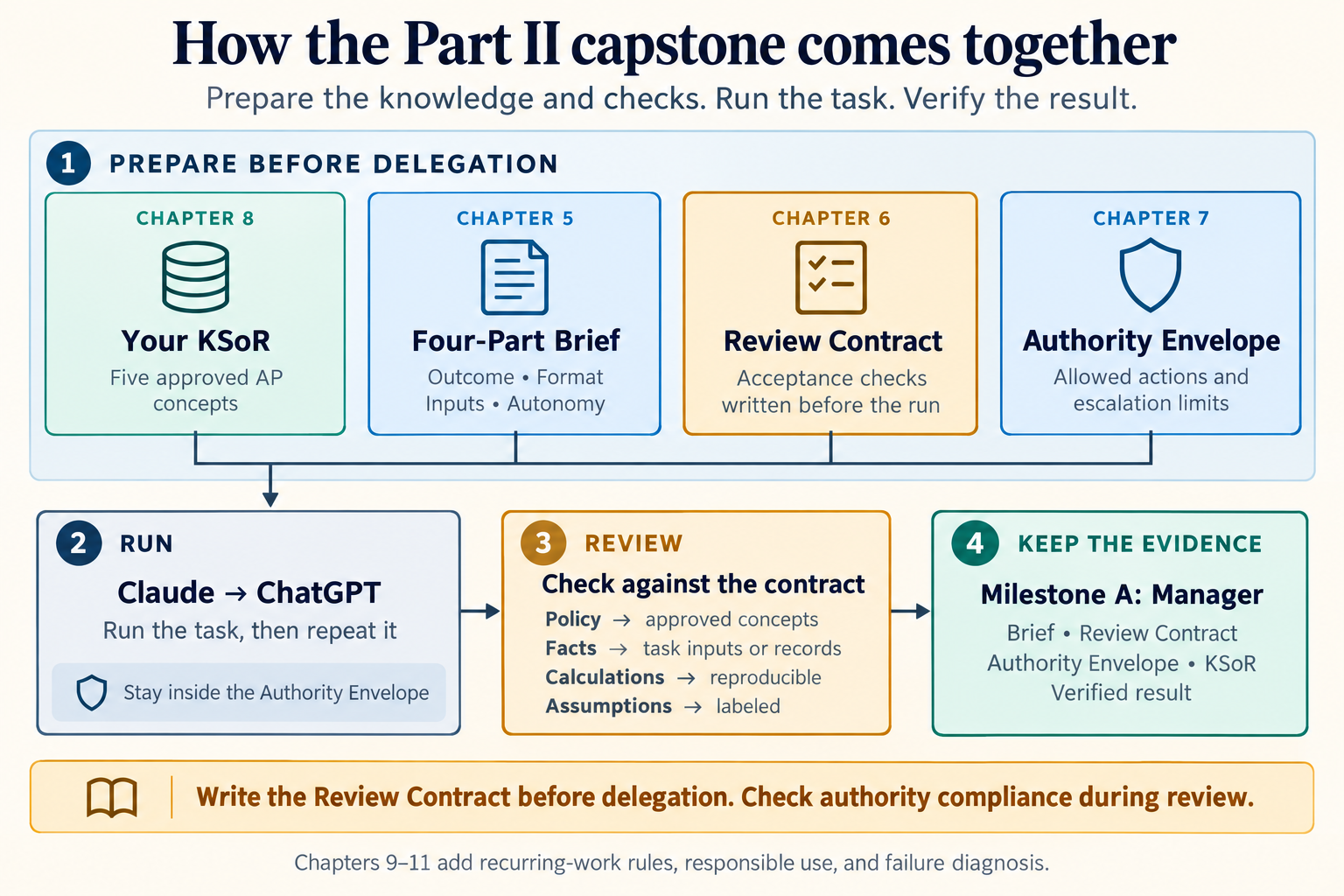
Figure II.3. How the Part II capstone is assembled. The knowledge and the checks come first. The run comes second, and the review comes third. The worker must stay inside the Authority Envelope during the run, and the rubric checks this under the governance criterion.
What you need
- Both AI vendors, if you can. The capstone runs in Claude and then in ChatGPT, and several labs compare the two. With only one account, you can still finish every lab and pass the capstone. Instead of the second run, write a short transfer plan. It lists the inputs, instructions, permissions and checks the other AI vendor would need. Mark it as planned, not tested.
- Plans. In Part II, many readers move to a paid plan with at least one AI vendor. This is because features such as scheduled work1 and longer tasks are often available on paid plans first.2 Each lab says what it needs, so check before you start.
- The lab folders. Each lab comes as a separate zip file from the Labs companion. It holds the data, templates, step-by-step instructions, troubleshooting and an answer key.
- Screencasts. Short screencasts, videos of five minutes or less, show Part II's hands-on steps on both AI vendors. Each one shows its date.
- Time. Each chapter takes about 30 to 45 minutes to read, plus about 15 minutes with its check-yourself questions. Each lab lists its own time. Plan extra time for Chapter 8, where you build your KSoR, and for the capstone.
How Part II prepares you for PCAO-F
Part I built foundations. Part II completes them. Together, the two parts teach every CCAO-F domain and the matching OpenAI competencies. The exam depth is in the Associate companion, described below. Take PCAO-F when you have finished Chapter 11 and worked through the companion.
On the Anthropic side, Part II covers five CCAO-F domains and completes the other two, Domains 3 and 5, which Part I started. The heaviest domain is output evaluation and validation, at 21 percent.3 It gets Chapter 6, the longest chapter in the part. The figure below shows each domain's main chapter.
On the OpenAI side, Part II covers the rest of the everyday-use competencies in the book's OpenAI competency map. They range from briefing a ChatGPT Work task to troubleshooting usage limits. Part I covered the first two. OpenAI publishes no exam guide this book can follow, so the book builds this map from OpenAI's documentation.
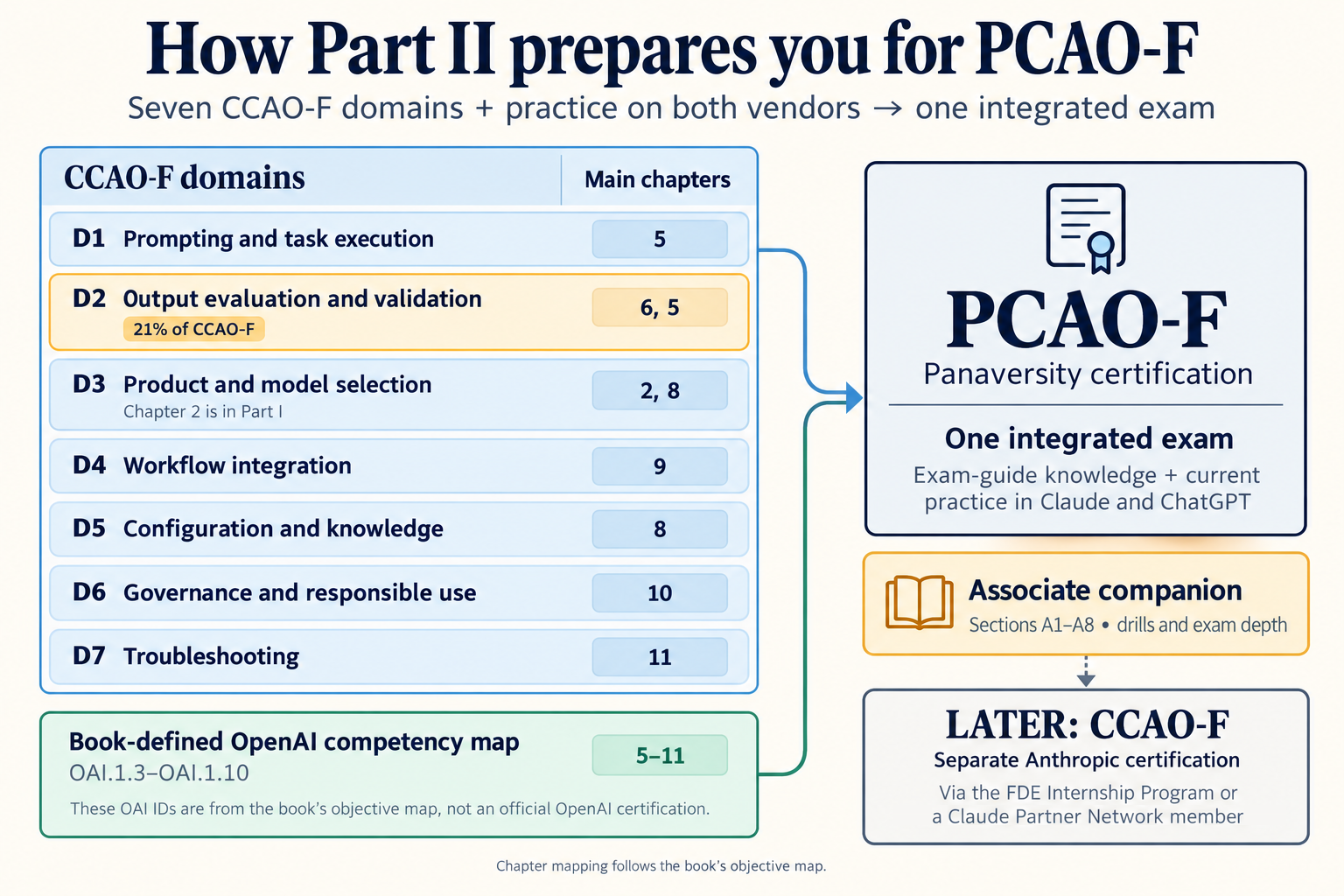
Figure II.4. How Part II feeds PCAO-F.
PCAO-F is one exam. It tests two things: the Anthropic exam guide, and current practice on both AI vendors.4 Each chapter ends with exam notes that show where the exam guide's wording differs from current practice. Quiz items are tagged blueprint when they follow the exam guide and current when they follow today's products. Learn both.
The Associate companion carries the exam depth that the book leaves out: drills on both AI vendors for every domain, and a snapshot rehearsal guide. Passing PCAO-F earns your first Panaversity certification. The official CCAO-F exam comes later. Passing PCAO-F and PCAR-F qualifies you for the FDE Internship Program. After you enter it, you can get assisted registration for CCAO-F: Panaversity helps you register. The Anthropic exams are optional.5 If you do not enter the internship, you need a member company that will register you.6
How to read this part
Read the chapters in order. Each one builds on the one before, and the capstone needs all seven. Do each lab when you reach it, because the capstone is assembled from them. Write the review contract before you run the task, every time. That habit is what this part teaches. If you get stuck, ask Zia Tutor AI. It is built on this book, and it can explain this part and quiz you on it.
Sources
- Plans and Pricing, Claude.↑
- Pricing, ChatGPT.↑
- Claude Certified Associate: Foundations Exam Guide, version 1.0, Anthropic, effective July 2026.↑
- Panaversity Certified Associate: Foundations (PCAO-F), The AI Agent Factory, first edition.↑
- Certifications: Proof You Can Carry In, The AI Agent Factory, first edition.↑
- Four role-based Claude certifications, Anthropic, 23 July 2026.↑
Check yourself
Recall and practice for the whole chapter: the flashcards, and a final quiz round from all seven concepts.
Chapter 5. The Four-Part Brief
How to brief an AI Worker in four parts (outcome, format, inputs and autonomy), split a large request into stages, improve a brief one part at a time, choose the format of the result, and run the same brief on Claude and on ChatGPT.