2.3 Worker, runtime and channel
- Status
- stable
- Owner
- Panaversity
- Approved
- Panaversity ·
In everyday life. A teacher's job stays the same when the school replaces her classroom computer, or adds a parent messaging app.
The Brightline review found three people describing one assistant three ways. Each was describing a real part, but none was describing the worker.
- The worker is the role itself: what it is responsible for, what it may do, and who answers for it. It is written down in a Role Contract, owned by the company, and given a name.
- The runtime is the replaceable harness that reasons and acts. A harness is the software that runs a model in a loop with its tools. It might be a coding harness, an agent toolkit or a hosted agent service. IT was pointing at part of this when it named the scheduled task. Its schedule, Monday morning, is a trigger.
- The channel, or workplace, is where people reach the worker: a chat app, a team messaging tool, email, a web portal or an API. Maria was pointing at a channel when she named the chat window.
Dave's shared project was none of these. It held standing context: the instructions and the policy copy that every chat in it started from. Standing context shapes the work, but it is not the worker itself.
Think of a human accounts payable clerk. Her job description stays the same when IT gives her a new laptop, and when the company adds a second phone line. The laptop is like her runtime, and the phone line is like a channel: either can be replaced. The job description is the role. If the job description changed every time the laptop did, nobody could manage her.
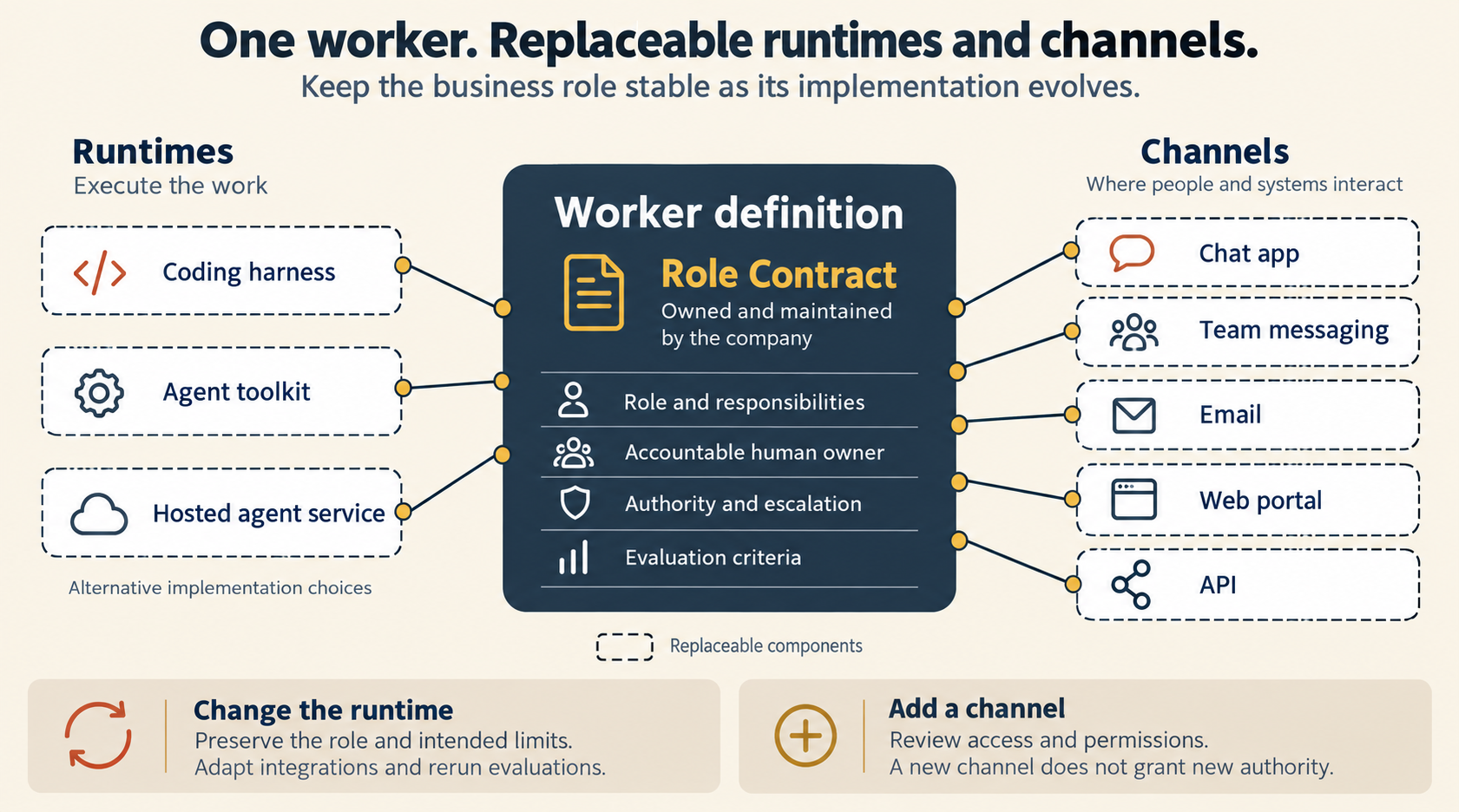
Figure 2.3. The worker is defined once. Runtimes and channels plug in and can be replaced.
This leads to the rule: never define a worker by its runtime or by its channel. Two tests check it. If you replace the runtime, the role, its intended authority and its evaluation cases must not change. The implementation does change, so you rerun the evaluations before you trust it. If you add a channel, the worker's authority must not grow. A worker that may only draft by email may still only draft in the team chat. Chapter 4 draws these layers in one architecture picture, and its dated boxes name each AI vendor's runtimes and channels.
Check yourself
Question 1 / 8 · current
0 answered
When Maria pointed at "the chat window," what was she naming?
2.2 Five things people call "AI"
What a model, an assistant, an automation, an agent and an AI Worker each are, how they nest, and two questions that tell them apart.
2.4 Choosing a surface and a model
How to choose a surface by the rung, when to add a project or research, how to choose the output by what must last, and three rules for choosing a model.