2.2 Five things people call "AI"
- Status
- stable
- Owner
- Panaversity
- Approved
- Panaversity ·
In everyday life. You go away for a week and leave three things to look after your house. A timer turns on the porch light at 7 p.m. every night, the same way each time. That is an automation. A voice assistant answers whenever someone asks it a question, one request at a time. That is an assistant. A house sitter looks after the whole house. They decide what each day needs, and they answer to you for how the week went. That is closest to a worker.
People use one word for five different things. Each one is useful. The AI Worker is the one built to be managed.
| Thing | What it is | Who decides the steps |
|---|---|---|
| Model | The trained engine that turns input into output. On its own it has no tools and no memory | Nobody. It produces one response |
| Assistant | A product that puts a model behind a chat for whoever is typing | The person, one request at a time |
| Automation | Fixed steps written in advance, run the same way every time | The person who wrote the steps |
| Agent | A model in a loop with tools. It plans, acts, checks and acts again | The agent, inside the task |
| AI Worker | A role, defined by its sixteen elements, with a named owner | The worker, inside its authority |
The five do not compete. They fit together. A model sits inside every assistant and every agent. An AI Worker usually does its work through an agent. It may also call automations for the steps that should never change, such as saving each invoice PDF to the right folder. An automation is still the right tool when the steps are known and judgment adds only risk.
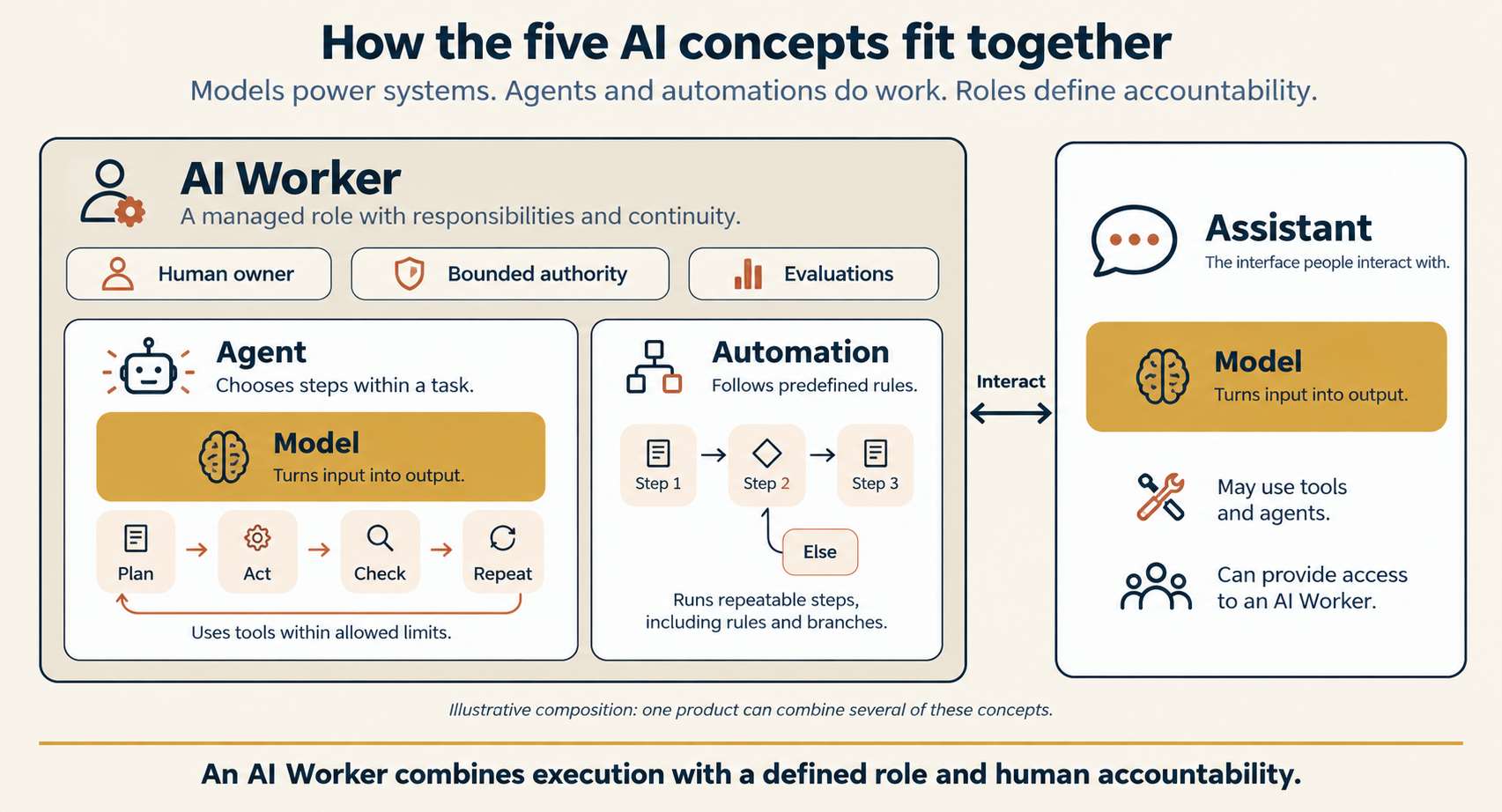
Figure 2.2. The five kinds fit together. A model sits inside every assistant and agent. A worker works through an agent and may call automations.
Two questions tell the five apart. The first is who decides the steps? The table answers it for each one. The second is who answers for the outcome? This question separates a worker from all the others. Ask both questions about how something is used, not about the product, because one product can be used in several ways. At Brightline, the clerk who happened to be typing used the assistant, but nobody answered for what it did. Brightline used an assistant as if it were a worker. An owner alone is still not enough. Someone in IT owns the script that saves invoice PDFs, and that script is still an automation. A worker needs the whole set: defined responsibilities, bounded authority, continuity (it keeps doing its work over time), evaluations and an owner who answers for its results. The sixteen elements in 2.1 spell out that set in full.
Workers also differ in how long they last. A Delegated AI Worker completes a briefed task on its own machine, then stops. It counts as a worker only inside a defined role with an owner (Chapter 1). A Standing AI Worker has a lasting identity, ongoing responsibilities and its own initiative. Chapter 9 teaches how to govern standing work.
Check yourself
Question 1 / 8 · current
0 answered
A script saves every invoice PDF to the right folder, the same way every time. What is it?
2.1 The anatomy of an AI Worker
The sixteen elements that define an AI Worker, sorted into five groups, and four pairs of elements that are easy to confuse.
2.3 Worker, runtime and channel
Why a worker is defined apart from the runtime that executes it and the channels people reach it through, and two tests that check it.