3.7 How the two leaders support the rhythm
- Status
- stable
- Owner
- Panaversity
- Approved
- Panaversity ·
In everyday life. Two banks both offer scheduled transfers. One asks you to approve every transfer from an account. The other asks you to approve only transfers to new payees, people you have not paid before. Either way, the safest account is one that no scheduled transfer can reach at all.
Both AI vendors let an everyday user hand over recurring work that runs while they are away: a scheduled task. That is where the rhythm is most at risk, because nobody watches the middle. Here is how the two AI vendors this book covers, Anthropic and OpenAI, support it today.
Anthropic, as verified 4 October 2026. Scheduled tasks in Claude Cowork and the new Claude experience are on all paid plans. Claude saves your prompt as the task's instructions and runs it hourly, daily, on weekdays, weekly or on demand, with your connectors and plugins. Tasks run remotely, so they run even when your computer is asleep. First 10: when you set a task up, you choose its approval mode. The modes are Manually approve, Automatically approve, and Skip all approvals. Anthropic documents this field for tasks set up manually in Cowork. Its steps for scheduling from a conversation in the new Claude experience do not mention it.1 Middle 80: in Automatically approve, Claude screens each action for safety before it runs. In Skip all approvals, nothing checks its actions. Even so, in every mode, Claude asks before permanently deleting files. Anthropic advises Manually approve when a task touches sensitive accounts or mistakes would be hard to undo, and advises against scheduling tasks that send messages or take hard-to-undo actions at all.2 Final 10: each run is its own session. You review past runs from the Scheduled page,1 and Anthropic advises checking the results after each run.2
OpenAI, as verified 4 October 2026. Scheduled tasks in ChatGPT run once, on a schedule, or as monitoring tasks, on every plan from Free upward, with limits by plan. Event-triggered tasks run in ChatGPT Work and respond to Gmail, Slack or GitHub activity, on Plus and above.3 First 10: you write the instructions. For an event-triggered task you review its Trigger, Condition and Prompt before relying on it. Workspace admins may control which app actions are permitted. Middle 80: connected apps read or act within the permissions you granted. An action that sends a message or changes external data may require approval. If it does, the task pauses until you review it. Final 10: you review results on the Scheduled page. If a task stops responding, OpenAI says to check there for a paused task or a pending approval.3
The difference that changes a decision. On Claude, oversight is one setting per task: the approval mode covers every action the task takes. On ChatGPT, approval applies to kinds of action, mainly sending and changing external data, within app permissions and admin policy. A pending approval pauses the task. So Brightline would design a Monday reconciliation differently on each. On Claude, Manually approve is set for the whole task, so every action in it that changes something waits for a person. The practical design is a task that only reads and reports, with any change made later in a reviewed run. On ChatGPT, the task can read freely, and it pauses when an action needs approval under the permissions and policy that apply. So the final 10 must include checking for paused tasks. On both, the strongest limit is access you never granted. A task with read-only access to the register cannot change it through that connection, as long as no other connected tool can write to it.
The invariant. Decide the limit in the Role Contract and the brief first, then turn it into whatever controls the product offers. A product setting can make a person decide. Only removing every access path makes an action impossible. Rules that need judgment, such as "stop if the gap cannot be explained," are stated in the brief on every product. Their measurable parts can also get automated checks, for example that the listed differences add up to the gap. The judgment itself is checked in the final 10. If you replace either AI vendor, that division stays the same.
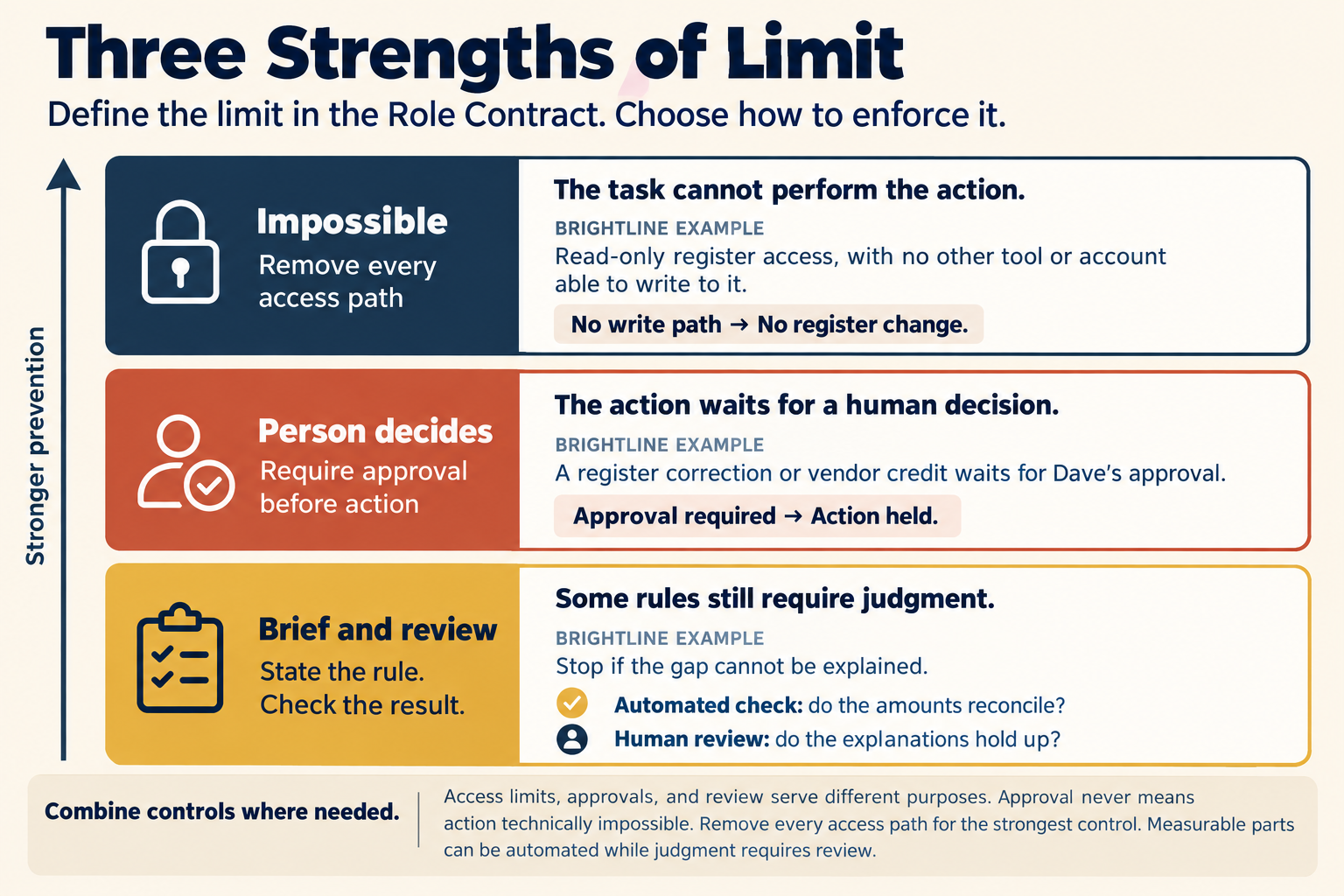
Figure 3.4. Three strengths of limit. Removing every access path makes an action impossible, an approval step makes a person decide, and a rule that needs judgment is stated in the brief and checked in the final 10, with automated checks for its measurable parts.
Check yourself
Question 1 / 8 · current
0 answered
On Claude's scheduled tasks, where is oversight set?
Sources
3.6 The three failures
The three ways the rhythm breaks, and three questions that show where to look first when a delegation goes wrong.
Build step: one AP task through the whole rhythm
Chapter 3's lab: one AP task run through the whole rhythm twice, then Draft 2 of the Role Contract and its limits on each AI vendor, with the artifact checklist.